
What a Hair Salon Website Needs: Five Jobs Before It Looks Pretty
Most hair salon websites are built to be admired, not used. Here are the five plain jobs a site has to do before it earns a single booking.

TL;DR
- A hair salon website has one job: get someone to book. Five things decide whether it does that: phone speed, visible prices, real photos of the actual work, one obvious way to book, and details that match Google exactly.
- Most salon sites lose bookings on the boring stuff, not the design: a PDF price list, autoplay music, a booking flow that takes five taps, or a phone number that does not match the Google Business Profile.
- Over three quarters of UK online time now happens on a phone, so a site that is slow or fiddly on mobile is losing the majority of the people who find it.
- The site does not need a page for every treatment, just the ones that actually drive bookings, each written to answer the questions a client has before choosing that treatment.
- A new website should sit alongside the booking software the salon already uses, not replace it.
Most hair salon website design is built to be admired by the owner on launch day and never used properly by anyone after that. They get a homepage the owner is proud of, a gallery that took a weekend to upload, and then nothing changes for three years while the salon quietly loses bookings to whichever competitor made booking easier.
There are over 50,000 hairdressing and beauty businesses in the UK, and the large majority employ fewer than five people. That matters for how a salon website gets built: the owner is usually the one who has to approve it, live with it, and eventually try to get it changed, not a marketing department with time to manage an agency relationship.
The site that actually earns bookings does five plain jobs. It loads fast on a phone. It shows the price list. It shows the team and their real work. It gives the visitor one obvious way to book or call. And the phone number and address on it match Google exactly. None of that is exciting to talk about, which is exactly why so many salon sites skip it in favour of a bigger hero image.
What Does Hair Salon Website Design Actually Need to Do?
A hair salon website needs to answer four questions in the first few seconds a visitor is on it: what do you do, what does it cost, who will do it, and how do I book. If a visitor has to hunt for any of those, they leave and search for the next salon instead.
That sounds obvious written down, and it is exactly what most salon sites fail to do. A homepage built around a large slideshow and a mission statement answers none of those four questions. A homepage with prices visible, a photo of the actual chairs and the actual stylists, and a booking button above the fold answers all four before the visitor has scrolled.
Does Your Site Load Fast Enough on a Phone?
Almost certainly not fast enough, and it matters more than any design decision on the page. UK adults now spend the large majority of their online time on a smartphone rather than a laptop or tablet, so a salon site is, for most visitors, a phone site whether it was designed as one or not.
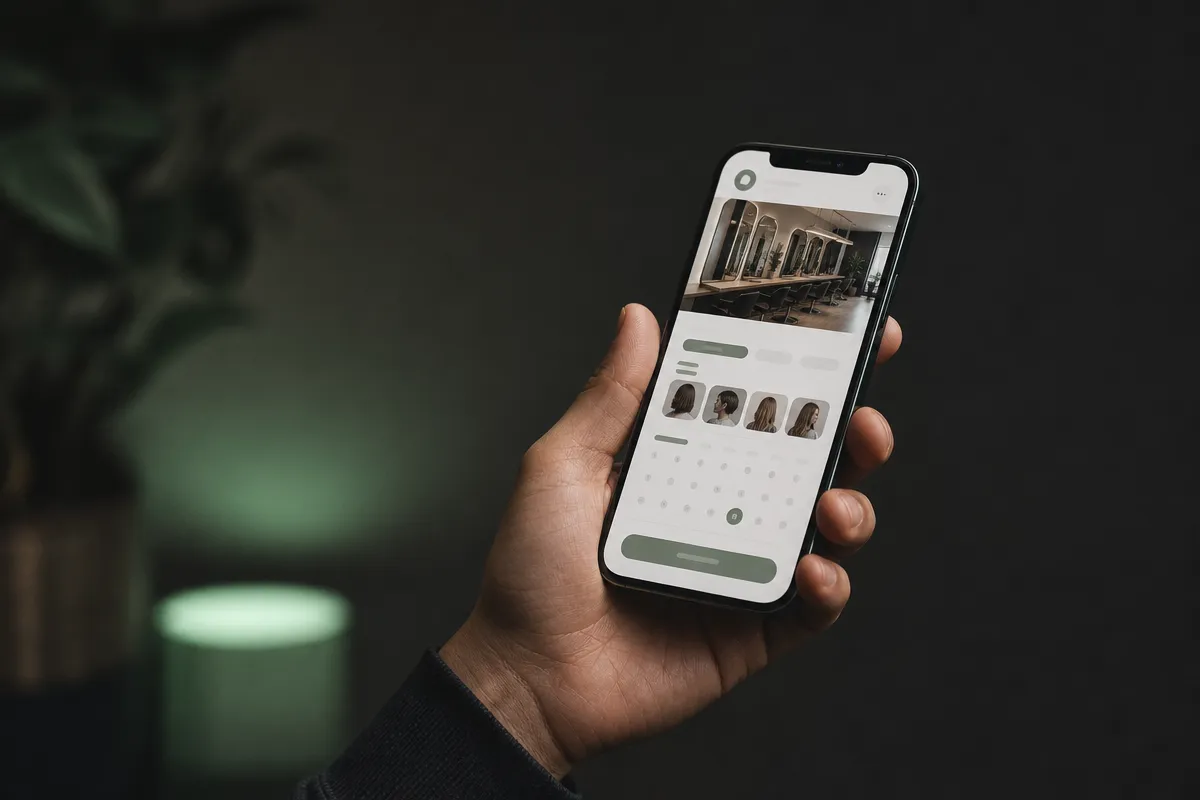
Google’s own guidance sets the bar plainly: a page should load its main content within 2.5 seconds to count as a good experience, and should respond to a tap within 200 milliseconds. Miss that by much and the numbers turn against the salon fast. More than half of mobile visitors abandon a site that takes longer than three seconds to load, and that the chance of someone bouncing rises sharply the longer the wait goes on.
Most of that speed problem is not the salon’s fault directly. It is the fault of a site built on a heavy template with five plugins nobody remembers installing, a gallery of ten-megabyte photos straight off a phone, and a booking widget loaded from three different third-party scripts. Fixing it usually means rebuilding the page rather than tweaking it.
Should Your Prices Be on the Website?
Yes, and hiding them is one of the most common reasons a visitor leaves without booking. A price list behind a PDF download, or missing entirely, sends someone straight to a competitor’s site where the price is just there.
Prices do not need to be exact for every possible variation of a cut or colour. A clear “from” price against each core service, updated when prices change, does the job. What kills trust is a page that lists ten services with no numbers at all, forcing a call just to find out whether the salon is even in the right price bracket.
What Pages Does a Hair Salon Website Actually Need?
Most hair salon websites either have far too few pages or far too many. The ones that book clients tend to stick to a short, deliberate list:
- Home: the five-second answer to what you do, what it costs, and how to book.
- Services and prices: every core service with a clear starting price.
- Team: real photos of the actual stylists, not stock photography, with what each one specialises in.
- Gallery: real work, ideally organised by service so a visitor looking for balayage sees balayage.
- Contact and booking: address, phone number, opening hours and the booking link, all matching Google exactly.
- A page each for the treatments that actually drive revenue: colour, extensions, or whatever the salon is known for, each answering the specific questions a client has before booking that treatment rather than being folded into a single generic services page.
That list is deliberately short. A salon does not need a blog nobody reads, a careers page for a team of three, or a separate page for every minor add-on service. Every extra page is another thing that can go out of date and another distraction from the booking button.
How Do Clients Actually Book Online?
Clients book online in one tap from wherever they already are, usually a Google search or a Google Business Profile, not by navigating through a website menu first. Google allows salons in the beauty category to add a direct booking link to their profile, so the booking step can start before the visitor ever reaches the homepage.
On the site itself, the booking button should be visible without scrolling, on every page, not just the homepage. A booking flow that takes five taps to reach an available time loses people who would have booked in one. This is not an argument for building a new booking system: the site should link straight into whatever the salon already uses to run its diary, whether that is Fresha, Vagaro, Treatwell or something else. The website’s job is to get the visitor to that booking screen as fast as possible, not to replace it. The booking screen is also where your deposit and notice terms belong, in front of the client before they confirm, and if you have not written yours yet there is a salon cancellation policy template you can adapt.
Why Must Your Phone Number and Address Match Google Exactly?
Because Google checks the two against each other, and a mismatch quietly costs the salon both trust and rankings. Google’s own listing guidelines say a business should be represented consistently across its website and its Google Business Profile, down to how the address is formatted and which phone number is used.
This is not a minor technical detail. The annual ranking factors survey puts consistent business information across the web among the clearer, controllable signals behind proximity itself, and reviews have become more heavily weighted than in previous years. A salon with one phone number on the website, a different one on Google, and a third on an old directory listing is actively working against its own rankings, and confusing anyone who tries to ring the number they found first.
The Mistakes That Cost a Salon Bookings
A handful of the same mistakes show up on salon site after salon site:
- Prices behind a PDF, or missing entirely.
- Autoplay music or video, which most visitors mute or close immediately, and which slows the page down for everyone else.
- A booking flow that takes more than two taps to reach an available time.
- A phone number or address that does not match Google, even by a formatting difference.
- Stock photography instead of the actual salon, which does nothing to show a nervous new client what they are walking into.
- A gallery with no structure, so a client looking for a specific style has to scroll through everything to find it.
None of these are expensive to fix. They are just easy to overlook when the focus during a rebuild is on how the site looks rather than what it needs to do.
What Should Hair Salon Website Design Cost?

It depends on what is included, and most quotes leave out the ongoing costs that matter more than the build price. A template site from a freelancer might cost a few hundred pounds up front and then nothing, until it needs updating and there is nobody left to call. A custom agency build can run into several thousand pounds before hosting, security updates or a single content change are even discussed.
I built every website for the aesthetics group I grew from one clinic to nine between 2016 and 2022, and I still run the site for it today, so the decisions above come from what actually moved bookings rather than what looked good in a portfolio. I have not run a hair salon myself, which is why the salon detail in this post is written from the client’s side of the desk rather than from a story I do not have.
I now run websites for clinics, salons and practices at £297 a month. There is no website build fee, no onboarding fee and no minimum term, and it covers the site itself, missed call text back, a review funnel, automated lead follow-up, one inbox for calls texts and messages, and a business phone number, on top of hosting and updates. It is not the only way to buy a salon website, and it will not suit everyone, but the figure is the figure: £297 to start, the first month, before the work begins, and the site is usually live in around 14 days.
Try the Test on Your Own Phone
Before spending anything on a rebuild, run the salon’s current site through the same test a client would: on a phone, on mobile data rather than wifi, starting from a Google search for the salon’s name. Time how long it takes to load. Count the taps from landing on the page to reaching an available booking time. Check whether the phone number on the screen matches the one on the salon’s Google Business Profile, character for character.
Most owners who run that test on their own site are surprised by the answer, and it is usually the same three or four things causing the problem, not a dozen.
Frequently Asked Questions
What makes a good hair salon website? A good hair salon website loads fast on a phone, shows real prices, shows the team and their actual work, gives the visitor one obvious way to book or call, and lists a name, address and phone number that match the salon’s Google Business Profile exactly. Everything past that is decoration.
How much should a hair salon website cost? UK salon websites range from a few hundred pounds for a template site to several thousand for a custom build, and most quotes leave out hosting, updates and ongoing changes. Resoclinx runs a hair salon’s website, missed call text back, review funnel, lead follow-up, one inbox and business phone for £297 a month, with no website build fee, no onboarding fee and no minimum term, and it is live in around 14 days.
Should a hair salon website show its prices? Yes. Hiding the price list behind a PDF or leaving it off entirely is one of the most common reasons a visitor leaves without booking. Showing even a starting price for each service removes the single biggest reason someone rings around instead of booking online.
Do I need a page for every service? Not every service, but the treatments that drive real revenue, such as colour, extensions or a specific technique the salon is known for, do better with their own page than a shared bullet list, because each one can answer the questions a client actually has before booking that specific service.
Why does my phone number need to match Google exactly? Google checks that the name, address and phone number on a website match what is on the Google Business Profile before it trusts either one fully. A mismatch, even a different phone number format, can quietly hold a salon back in local search results and confuses a client trying to ring.
Can I keep using Fresha or another booking system with a new website? Yes. A new website does not replace the booking software already running the diary. It sits alongside it: the site links straight through to the existing booking page so the client still books into the same calendar the salon already uses.
If the site is quietly costing bookings, the fix is rarely a full redesign. It is usually the five plain jobs above, done properly, and a book a call is the fastest way to find out which of them yours is missing. The call is thirty minutes, and it is a straight answer, not a pitch.
Every hair salon is different in what it needs from its site, and every clinic, salon or practice Resoclinx builds for gets your website built for its own niche, not a template with a new logo dropped in. Full detail on what is included and what it costs sits on the pricing page.