AI Receptionist for Small Business: Complete 2026 Guide
Most small businesses miss almost half their calls. An AI receptionist closes that gap, day or night, without a hire. Here is what to look for in 2026.
TL;DR
- An AI receptionist is software that answers calls and messages for a small business 24/7, qualifies the enquiry, and either books a callback or hands a warm lead to your team.
- Small businesses miss 47% of initial calls and most of those callers do not call back. An AI receptionist closes that gap without a new hire.
- Pricing in 2026 ranges from roughly £30 a month for a basic single-channel bot up to £500 a month for a full multi-channel platform. The right tier depends on call volume and how much else you want bundled.
- The best AI receptionist for a small business is not the one with the most features. It is the one trained on your industry, your customers and your booking flow.
- Done well, an AI receptionist replaces missed calls and dropped DMs, not your receptionist. The team handles humans in the room. The AI handles the moments the team physically cannot.
It is 6:42pm on a Tuesday. The clinic owner has just locked up. Her phone rings. She lets it go to voicemail because she has a child to pick up and a dinner to start, and she will deal with it tomorrow.
The caller does not leave a message. Most callers do not.
The next morning the team checks the inbox. There is no missed-call note, no enquiry log, no name. Whoever called is gone. They probably booked with another clinic that picked up.
This is the gap an AI receptionist fills for a small business. Not a futuristic fantasy. Just an answer to the call you cannot take, every time.
This guide explains what an AI receptionist for small business actually does in 2026, what it costs, what to look for when choosing one, and how to roll it out without disrupting the way your team already works.
What Is an AI Receptionist for a Small Business?
An AI receptionist is software that answers your business phone, replies to your messages, and qualifies enquiries 24/7, without needing a human at the desk.
In plain terms, it picks up the call, has a natural-sounding conversation with the caller, asks the questions a good receptionist would ask, then either books a callback for your team or hands the caller off live to whoever is on duty.
Most modern AI receptionists also handle text messages, WhatsApp, web chat and social-media DMs from the same trained agent. So when somebody messages your Instagram at 10pm, they get a reply in seconds rather than waiting until your team logs in the next morning.
The reason this matters for a small business is structural. A small business does not have a dedicated reception desk staffed 9 to 5 with overflow cover. Most small businesses have one person doing five jobs at once. The phone rings while the owner is mid-treatment, mid-quote or mid-school-run. So calls get missed.
An AI receptionist is not a robotic auto-attendant pressing menu options. It is a conversational layer that catches the work the team physically cannot get to, then quietly hands it back when somebody is free.
For service businesses, especially aesthetic clinics, salons, dental practices, fitness studios and small medical practices, the gap is bigger than most owners realise. We cover the wider category in detail on the AI receptionist page.
Five Signs Your Small Business Needs an AI Receptionist
Most small business owners can tell you their phone rings too much. Fewer can tell you what it costs them. Here are the signals that the missed-call problem is real, not just noisy.
Sign one: your team is letting calls go through to voicemail and you know it. Every time a customer hits voicemail, you have lost a chance. 85% of callers do not leave a message and do not call back.
Sign two: enquiries are landing in five different inboxes. Phone, email, web form, Instagram DM, Facebook Messenger, WhatsApp. Nobody owns the lot. Things slip through.
Sign three: response times are slow and you cannot fix them with people. Hiring more reception cover is expensive and the demand is uneven. Calls cluster around school runs, lunch and weekends. You cannot staff a person to those peaks.
Sign four: weekends and evenings are dead for follow-up. Customers research at 9pm. They book at 10pm. If your business cannot reply until Monday at 9am, the lead has gone cold or moved on.
Sign five: you are missing the same kind of enquiry over and over. New customers asking the same five questions. Your team explains pricing seventeen times a week. The AI can answer those without anyone in the loop, so the team can spend their time on the conversations that actually need a human.
If two or more of these are true, an AI receptionist is probably going to pay for itself in the first month.
What an AI Receptionist Actually Does (and What It Should Not Do)
A good AI receptionist for a small business should handle these things on its own:
- Inbound calls during the gaps your team cannot cover, including evenings, weekends and peak times.
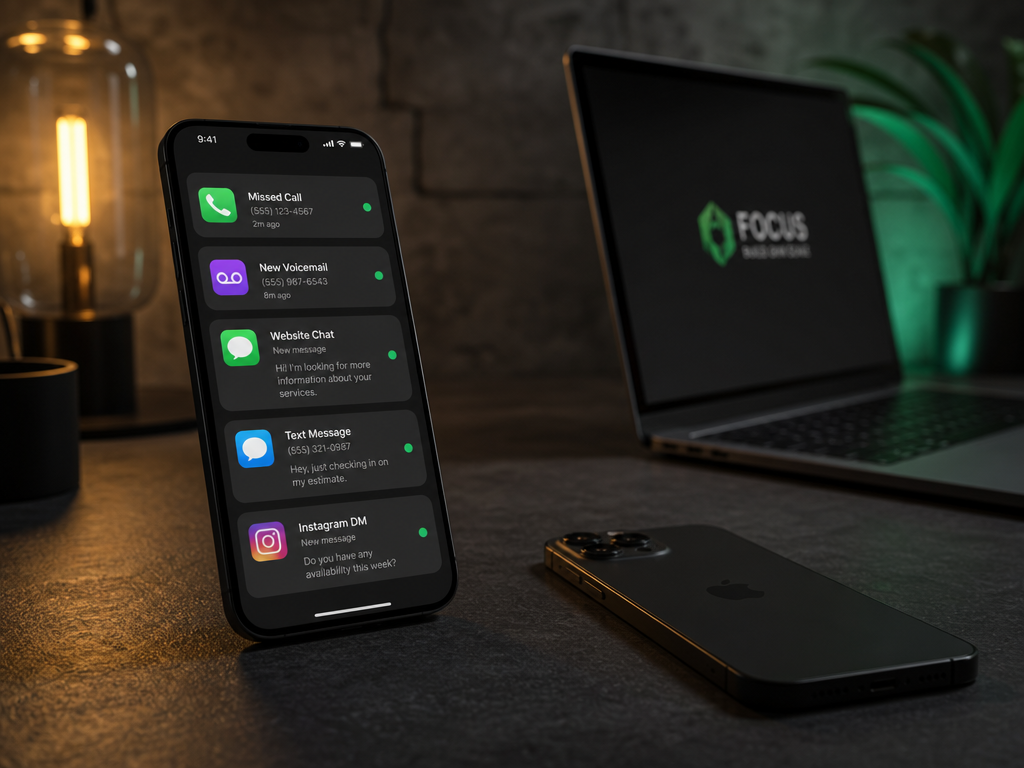
- Missed-call text-back within seconds, so a dropped call still produces a thread you can pick up.
- Qualifying questions to filter the time-wasters from the genuine enquiries before a human gets involved.
- Answers to routine questions about pricing, opening hours, location, services and booking process.
- Callback scheduling so the caller leaves with a clear next step rather than a “we’ll get back to you”.
- Cross-channel coverage, not just voice, so an Instagram DM at midnight is handled the same way as a phone call at 11am.
- Escalation to a human for anything sensitive, complex or outside the script.
What it should not do:
- It should not give specialist advice. For clinics, that means clinical advice. For lawyers, legal advice. For accountants, tax advice. The AI captures the question and routes it to the qualified human.
- It should not be the only contact a customer ever has. AI is the gap-filler. The human follow-up is what actually closes the work.
- It should not write directly into your operational system if that risks duplicates. A safer pattern is to capture the enquiry and propose a callback, then let your team make the booking inside whatever software you already use.
The split is simple. The AI handles volume and speed. The human handles judgement and relationship. Get that right and the AI does not feel like a robot. It feels like a quietly competent member of staff who never sleeps and never gets flustered.
For our clinic clients, that split usually means the AI handles voice, WhatsApp and DMs, books a callback, then hands a fully qualified lead to the receptionist with the conversation history attached.
How Much Does an AI Receptionist Cost in 2026?
Pricing for AI receptionist software in 2026 generally falls into three brackets, and which one fits depends on the volume and the channels you need.
Bracket one: basic AI voice bot, around £30 to £80 a month. Single channel, usually voice only. Good if you literally just need somebody to answer the phone after hours and take a name and a number. Not great for qualification, not great for messaging, not industry-trained.
Bracket two: mid-range platforms, around £150 to £350 a month. Voice plus chat plus a basic CRM. Better at qualifying. Usually generic across industries, so the language is not tuned to your business. You will probably bolt on a separate review tool, a separate calendar tool and a separate marketing tool to make it work end to end.
Bracket three: industry-specialist platforms, around £300 to £700 a month plus a one-time setup. Trained on your industry, multi-channel, integrates with the booking software you already use, and bundles the things you would otherwise pay for separately (reviews, follow-up, retention). Higher up-front but lower total cost of ownership once you account for what is already inside.
Resoclinx is not in any of those three brackets, because it is not an AI receptionist. It builds and runs the website and the follow-up around it, at one flat monthly rate with no minimum term. If your suspicion is that the enquiries are dying after the call rather than during it, that is worth a conversation.
The honest answer to “what does it cost” is that the headline number on the website is rarely the whole bill. Add the receptionist subscription, the review tool, the booking-software bolt-ons and the agency retainer and most small businesses are spending more than they realise. Consolidating into one platform usually wins on cost as well as on coordination.

What to Look for When Picking AI Receptionist Software
If you are evaluating AI receptionist software, the criteria below tend to separate the tools that work in real life from the ones that demo well and disappoint in the diary.
Industry training. Generic AI sounds polite and answers questions vaguely. Industry-trained AI knows the words your customers actually use, the price brackets that feel normal in your category, and the qualifying questions that filter a serious enquiry from a tyre-kicker. For clinics, that means treatment-specific vocabulary. For accountants, it means knowing the difference between sole trader and limited company.
Multi-channel coverage from one trained agent. Customers do not stay on one channel. They call, then DM, then WhatsApp. If you have a different bot or a different rep on each channel, the customer experience is fragmented and your data is split. One trained agent across voice, web chat and messaging is far cleaner.
Integration with the software you already use. If the AI receptionist forces you to throw out your booking software, your CRM or your invoicing tool, the upgrade is going to be painful. The strongest tools sit in front of what you already run, capture and qualify, then hand a clean booking to your team in the system you know.
Speed of response. This is the whole game. Leads contacted within 5 minutes are far more likely to convert. In specialist sectors like healthcare, the gap is even wider, with leads contacted at the 5-minute mark up to 21 times more likely to convert. The AI should respond within seconds, not minutes.
Human escalation, not human replacement. A good AI receptionist knows when to step back. It flags clinical, legal or complex enquiries to the human team with the conversation context attached. If the platform pretends it can handle everything, that is a red flag.
Transparent pricing. Per-call billing looks cheap until your traffic spikes. Flat monthly pricing is usually safer for a small business. Watch for setup fees, channel-by-channel add-ons and review-tool bolt-ons that turn a £150 quote into a £600 bill.
Reporting that tells you what your team actually needs to know. Number of calls captured, time of day, source channel, qualified versus unqualified, booked versus dropped. If the dashboard cannot answer those questions in 30 seconds, it is not the right platform.
AI Receptionist vs Traditional Virtual Receptionist Services
Before AI, the alternative to your own receptionist was a virtual receptionist service. A team in a call centre answers your phone in your business name, takes a message and sends it on. Smith.ai, AnswerConnect and Ruby Receptionists all sit in this category.
These services still have a place. The voice is human, the escalation is instant, and you can hand off complex or unusual conversations cleanly.
Where they fall short for a small business is cost and consistency. A human virtual receptionist service typically charges per call or per minute, so a busy month produces a bigger bill than a quiet one. The receptionist also rotates between many businesses, so the depth of knowledge about your specific services, prices and processes is limited.
An AI receptionist solves both problems. The cost is flat. The training is deep, because the AI is configured once around your specific business, then runs on rails. And it answers in parallel, so a lunch-rush spike of twelve calls in twelve minutes does not produce voicemail or a wait queue.
For a small business doing serious volume, the right answer is often a hybrid. Use AI for the routine work and the after-hours coverage, with human escalation for anything sensitive or complex. That is how most modern AI receptionist platforms are built.
How to Roll Out an AI Receptionist in Your Small Business
Rolling out an AI receptionist properly takes about a week if the platform you choose is set up for small businesses. Here is the broad shape of it.
Day one to two: scope and configuration. You and the platform team agree on the set-up, voice, opening greeting, qualifying questions, escalation rules, and the answers the AI should give to your most-asked questions. This is where most of the setup time actually goes.
Day three to four: integration. The AI is connected to your phone number, your messaging channels and your shared calendar. If the platform is sensibly built, it does not touch your booking software or your customer records. It captures and qualifies, and then hands the booking to your team for them to enter into the system you already use.
Day five to six: testing and tuning. Real test calls are made and the conversation script is tightened. Edge cases are added to the AI’s training. The team is shown how to monitor the inbox.
Day seven: live. The AI starts taking calls. Your team gets used to seeing qualified enquiries land in the inbox without anyone having to chase them. The first week is the noisiest, because the AI is learning your patterns. After that the rhythm settles.
A few things that help the rollout go smoothly:
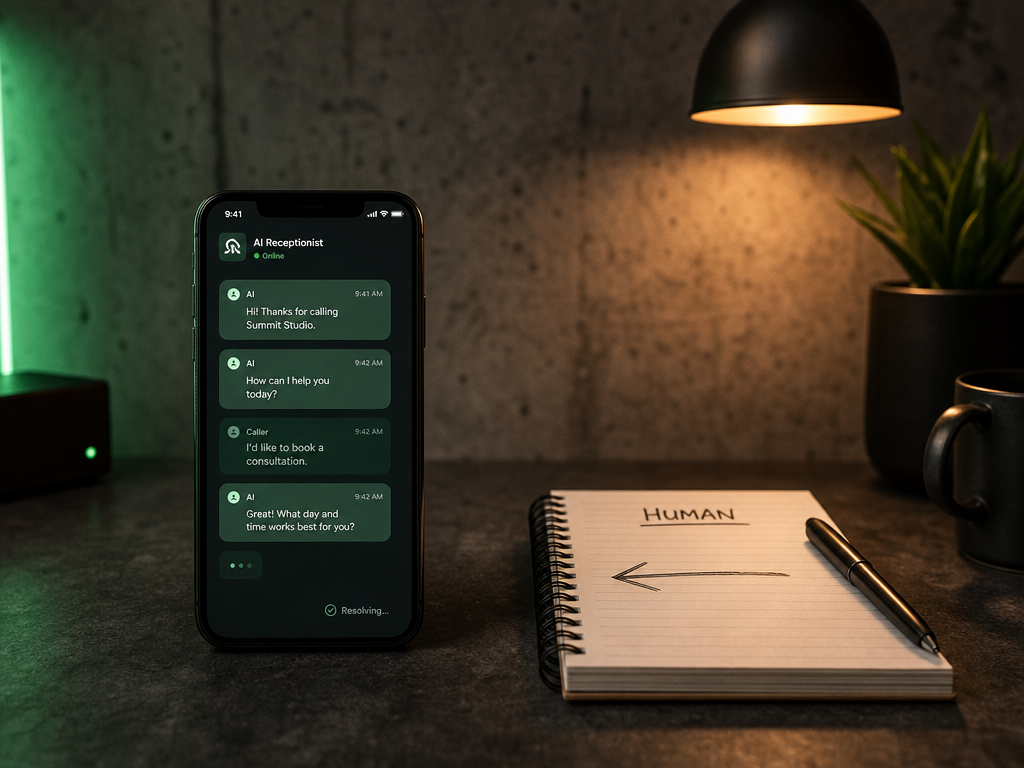
- Do not switch the team off. The AI is not replacing them. It is covering the gaps. Tell the team that explicitly, on day one.
- Listen to the first 30 calls. Most platforms record and transcribe every interaction. Listening to the first batch is how you spot the awkward phrasing or the missing answer that needs to go into the AI’s script.
- Measure the obvious things. Calls captured. Bookings produced. Hours of overnight coverage. The numbers will tell you whether the platform is paying for itself within the first month.
A Final Note on AI Receptionists for Service-Based Small Businesses
To be honest, an AI receptionist is not magic. It is just a way to make sure the work that lands when your team cannot answer does not disappear.
For a service-based small business, especially a clinic, salon or any business where the phone rings during a customer interaction, the missed-call gap is the single biggest thing leaking money from the business. Closing it does not require a new hire or a longer working day. It requires software that picks up when your team cannot.
If you want to find out how many enquiries your business is currently leaking, the fastest honest answer is to count them for one week: every call, every DM, every form, and what happened next to each. Most owners do not need a tool to find the gap once they have written it down.
The right AI receptionist for your small business is the one that fits your industry, your team and the way you already work. Get that right, and the question stops being “are we missing calls” and starts being “what do we do with all these new enquiries”.
Want me to look at yours?
Thirty minutes with the person who would build it. Tell me what you do and where the work comes from now, and I will tell you straight whether a rebuild would change anything. If it would not, I will say so.
Book a callNot ready for a call? Take the slow road. One short email every Tuesday from Surinder: one thing to check on your own website, phone line or reviews. Five minutes, no ads.