Some come in while you are in the treatment room. Some come in at ten past seven in the evening, when she has finally sat down and started thinking about her jawline. Some come in on a Sunday.
You already know what happens to most of those. The phone rings out, or it goes to a voicemail nobody has ever left a message on, or your receptionist takes a name on a Post-it and gets pulled into something else.
This page is about the part of the system that catches them. It is the first thing we put in, and for a lot of clinics it is the only thing they need.
These are the rules from the guide, running on their own
If you have read The Front Desk Rules, you already know what should happen when somebody contacts your clinic. Reply instantly. Let her book her own callback. Follow up until she books or tells you to stop. Never quote a price on the phone.
None of that needs software. You could do all of it with a diary and a member of staff who never has a day off, never gets pulled into a room, and never forgets.
That is the actual problem. The rules are not hard. Remembering them at half past six on a Friday, when you are the one holding the syringe, is.
So this is those rules, running whether anybody remembers them or not.
The AI receptionist
When nobody can get to the phone, it answers.
It takes her name and number. It answers the ordinary questions, the ones your receptionist answers forty times a week: where you are, what the parking is like, whether you do that treatment, how long it takes, whether there is downtime.
Then it books her a callback slot that she chooses herself. Not "someone will get back to you." An actual time, that she picked, when she said she was free.
It does not quote a price. That is not it being cagey. It is rule one from the guide, and it applies to a machine for the same reason it applies to a person. A number without a consultation behind it is just a number to compare against the clinic down the road.
The next morning your receptionist is not cold-calling a stranger off a list. She is ringing somebody at a time that person chose, about a treatment she has already asked about. Those two calls are not the same call, and they do not convert at the same rate.
Does it sound like a robot
Everybody asks this, and it is the right question. A bad one loses you more patients than no answer at all, because somebody who has been annoyed by a machine does not ring back.
I am not going to tell you it sounds human. Everybody in this market says that, and you have no reason to believe any of us on a web page.
So ring it. 07445 162296.
It answers as Bright Skin Clinic, which is not a real clinic. It is a working agent set up exactly the way yours would be. Ask it something awkward. Ask it what something costs. Talk over it. Ask it a question it has no business being able to answer. It will not give you a price, because that is rule one, and you will find out inside two minutes what it does when it is out of its depth.
If it is not good enough for your patients, you have learned that for the price of a phone call and you can close this page. I would rather you found out now than in your first month.
A missed call gets a text back on its own
If the phone rings out, she gets a message within seconds. It says who you are, that you have missed her, and asks what she was after.
This is the single highest-value thing in the system and the one owners underestimate most. It costs almost nothing to run and it works on the calls you were already losing, so there is no new marketing spend attached to it.
A large share of people who ring a clinic and get nothing will simply ring the next clinic on the list. A text back inside a minute stops that, because now there is a conversation open and she does not need to start again somewhere else.
Follow-up that runs whether anyone remembers it
Most enquiries are lost after the first contact, not at it.
She rang, said she would have a think, and nobody ever went back to her. She booked and did not turn up. She filled in a form at eleven at night and got a reply four days later.
Follow-up runs across text, email and WhatsApp, on a sequence, until she books or asks you to stop. It chases the ones who said they would think about it. It chases the no-shows. It does not get embarrassed and it does not decide today is a bad day to bother her.
The people already in your records
Everybody who came in eighteen months ago and never came back is sitting in your patient records doing nothing.
They already know you. They already trusted you once. Working that list is usually the fastest money in the building, and it costs you nothing in advertising, which is why it sits in stage one rather than waiting for a budget.
Reviews, and why they actually come in
Most clinics ask once. Something goes out from whatever software they use, it lands in an inbox underneath forty other emails, and that is the end of it. Then the owner decides that patients do not leave reviews.
Patients leave reviews. They just do not leave them because of one email.
Here is what goes out instead.
A WhatsApp message, not an email. That matters more than it sounds like it should. WhatsApp is where she already is, and the phone she is holding when the message arrives is the same phone she would leave the review on. Nothing has to be opened on a laptop later. It goes out from here, not from your clinical software, so it does not matter what you run.
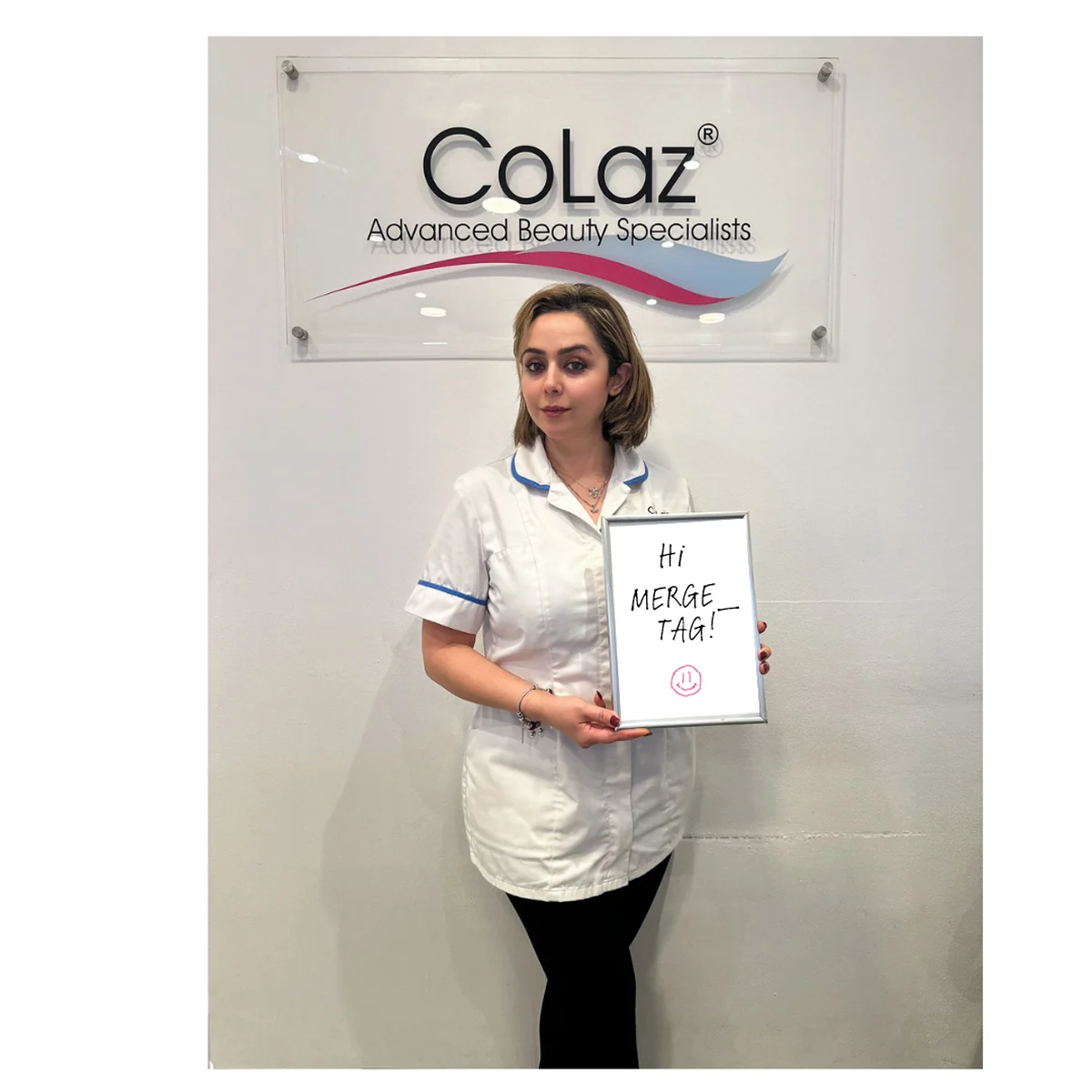
And there is a photograph in it. You, holding a board with her name written on it.
You take that photograph once, holding a blank board. Her name is written into it automatically as the message goes out. Every patient gets a picture of you holding up her own name, and after the morning you take the photo you never touch it again.
That is the part that does the work. She has just spent an hour with you. Now there is a picture of you holding her name up. It does not read as a system talking to a customer, even though that is exactly what it is, and people do not ignore it the way they ignore a request from a no-reply address.
Then it follows up. A day later. Then a gap of a few days, then again. If she leaves the review it stops there, because the automation picks it up and opts her out. If she does not, it goes once more. Emails run alongside it.
Three or four touches, not one. That is most of the difference between a clinic with a handful of reviews and a clinic with a wall of them, and it is not because one of them has better patients.
You get told when a new one lands, good or bad, so you hear about a problem before the rest of the internet does.
This is running live across the seven clinics I work with.
Your Google profile, from the same place
Posts, photos, opening hours, the questions people ask on it, and the reviews feeding it.
For a local clinic that profile is often worth more than the website, because it is what somebody sees when they search on their phone two streets away and never clicks through to anything. It costs nothing to run. That is why it is here and not in stage two.
You can finally see where they came from
Every enquiry is tagged with where it came from. The Google profile, the website, an Instagram message, a form, the phone.
For most owners this is the first time they have ever had that, and it is usually uncomfortable reading. It is also the only way to stop guessing about what to spend money on.
What this does not do
I would rather you knew now than three weeks in.
It does not book into your diary. It books a callback. Your team converts that call. This is a deliberate decision, not a gap we are covering up. Aesthetic treatments need a human conversation before somebody commits, and a machine dropping appointments straight into a clinical diary causes more problems than it solves. Plenty of systems in this market promise direct booking. Ask them what actually lands in the diary.
It is not clinic management software. No patient records, no treatment notes, no consent forms, no daybook. If you run Pabau, Fresha or Cliniko, it stays exactly where it is. This works in front of it, not instead of it.
It cannot manufacture demand. If almost nothing is coming in, better follow-up will not save you. That is a visibility problem, and it is stage two, not this.
Who this is not for
- Anybody who wants more leads poured into a front desk that is already dropping them. Fix this first, then advertise. The other way round is the most expensive mistake available to you.
- Anybody who wants to hand it over completely and never look at it again. It needs you interested for the first few weeks, while it learns how you actually talk about your treatments.
- Anybody looking to replace their clinical software. That is not this.