
Part one: the phone
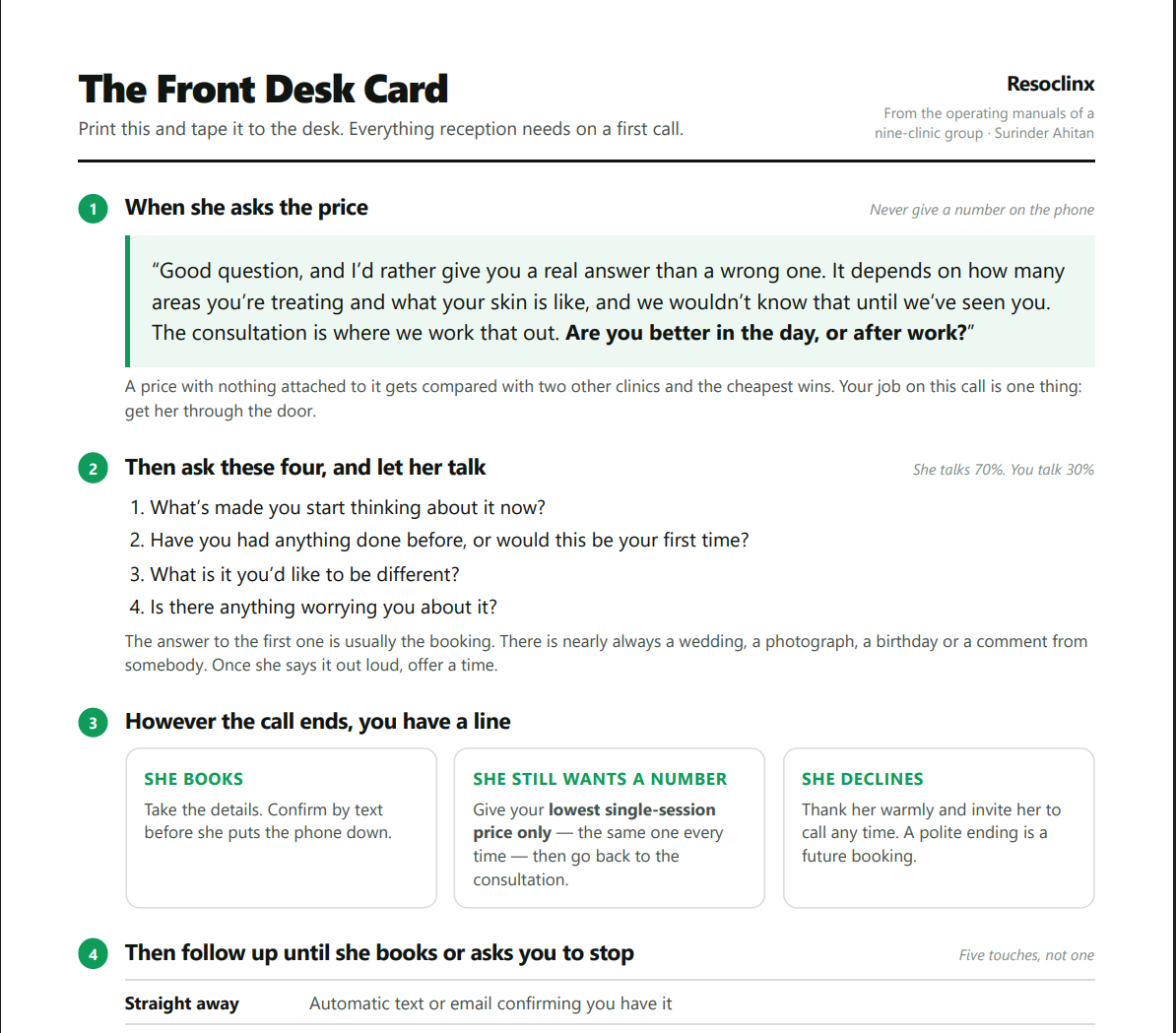
Rule 1. Reception never gives a price over the phone
This is the one that costs the most and the one nobody believes until they try it.
When someone rings and asks "how much is Profhilo", and your receptionist says "£250", you have just handed her a number with nothing attached to it. She rings two more clinics, gets two more numbers, and books the cheapest. You have competed on the only thing you cannot win, against a clinic you have never seen.
Price is not information at that stage. It is a way of ending the conversation.
The job of that call is one thing: get her through the door.
What to say instead. Acknowledge the question, explain honestly why you cannot answer it properly on the phone, and offer the thing that can:
"Good question, and I would rather give you a real answer than a wrong one. It depends on how many areas you are treating and what your skin is like, and we would not know that until we have seen you. The consultation is where we work that out. Are you better in the day or after work?"
Nobody is being evasive. It is true. The number depends on the assessment.
Then the price gets closed in the room, by the clinician, after the assessment. That is where it belongs. The receptionist gets her in. The clinician earns the fee.
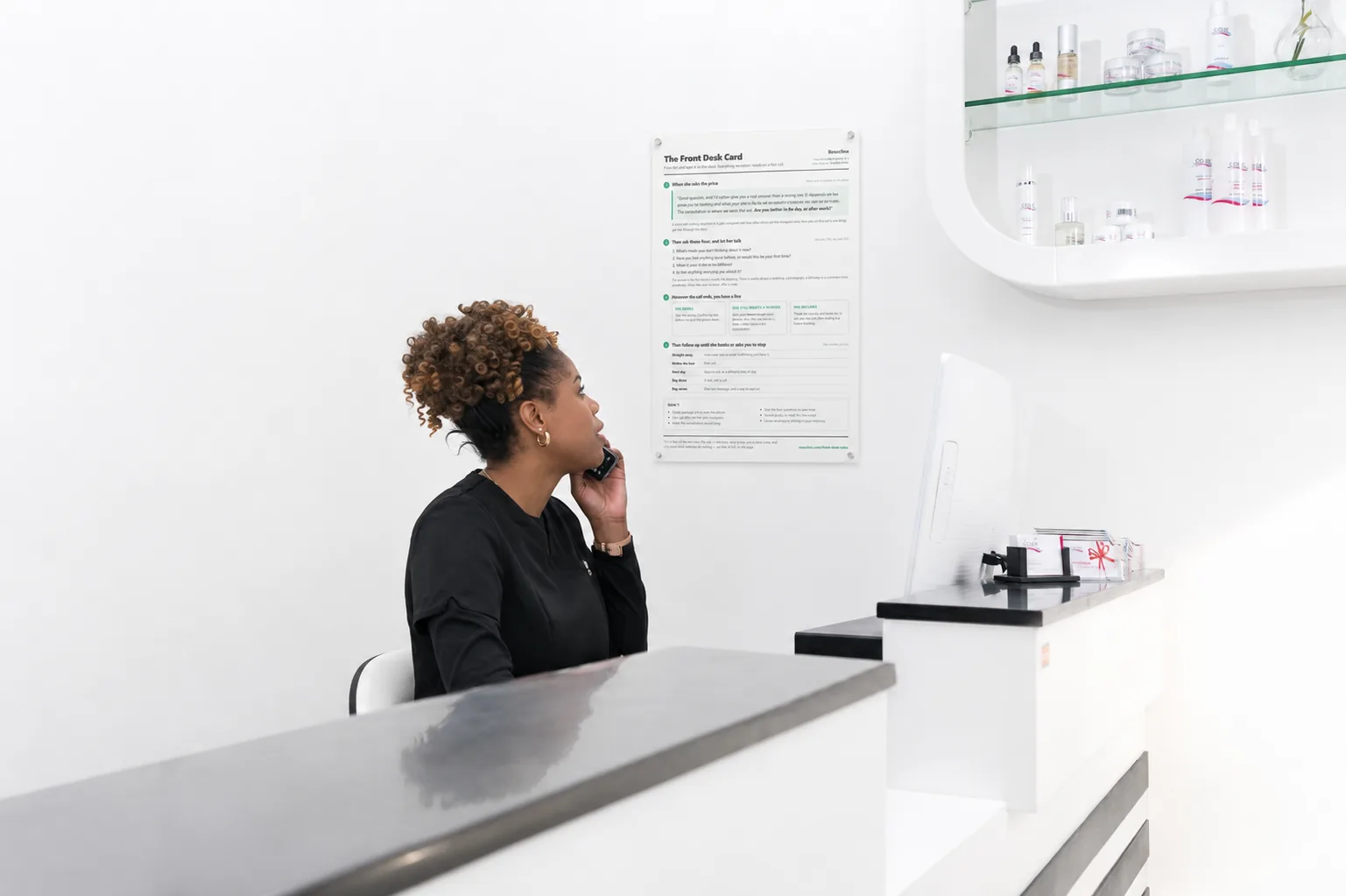
Monday morning: write the sentence above on a card and tape it to the desk.
Rule 2. The caller talks seventy per cent of the time
Listen to three of your own calls and time it. Most receptionists talk about eighty per cent of the time. They think being helpful means explaining everything.
Turn it round. She should talk seventy. Reception talks thirty.
People book when they have finished explaining their problem, not when they have finished hearing your list of treatments. A woman who has told you she has been putting this off for two years, that it is her sister's wedding in October, and that she is nervous about looking overdone, has effectively booked herself. Nobody sold her anything. She talked herself into the room.
Monday morning: listen to three calls with a stopwatch. Do not tell your receptionist what you are measuring until afterwards. Then show her the numbers. It lands better than any training session.
Rule 3. Ask questions. Do not pitch treatments
Related to rule 2, and the practical way to achieve it.
The receptionist's job is not to know every treatment. It is to ask three or four good questions and listen to the answers.
- "What is making you think about it now?"
- "Have you had anything done before, or would this be your first time?"
- "What is it you would like to be different?"
- "Is there anything worrying you about it?"
The answer to the first question is usually the booking. There is almost always an event, a photograph, a birthday or a comment from somebody. Once she says it out loud, she has committed. Your receptionist has only to offer a time.
Monday morning: those four questions on the same card as rule 1.
Rule 4. Let her book her own callback
Most clinics ring people back cold. The patient enquired on Tuesday evening, somebody rings on Thursday lunchtime while she is at work, and it goes to voicemail. Then everyone agrees that leads are rubbish.
Turn it round. Let her pick the slot.
When she picks it, three things change. She is expecting the call, so she answers. She has chosen a time she can talk, so she talks properly. And she has made a small commitment already, which makes the next one easier.
This is the change that moved the needle furthest in the clinic I know best. Same receptionist, same treatments, same prices. The calls simply stopped being cold.
Monday morning: even a simple booking link in your reply is enough to start. It does not need to be automated to work.
Part two: the follow-up
Rule 5. Something must reply the instant an enquiry lands
Not when reception is free. Not after this client is finished. Immediately.
Here is what that is worth. At our London clinic we were spending £2,000 a month with a Google Ads agency. Every month they showed us clicks, cost per click, and conversions, and the numbers looked respectable. But their "conversion" was somebody filling in a form. When we rang those people a few hours later, half of them were not interested any more and the rest never picked up.
So we blamed the agency for sending rubbish leads, and the agency blamed us for being slow off the mark. We were both partly right. But the actual problem was that there was nothing in between the form and the phone call.
A text that arrives in ten seconds saying "thanks, we have got your message, someone will call you shortly" beats a perfect phone call four hours later. Every time.
Monday morning: if you have nothing else, set an auto-reply on the enquiry form and put your mobile number in it.
Rule 6. Follow up until she books or tells you to stop
Your receptionist rings once. No answer. She means to try again, and then a client walks in and it is gone. That is how most enquiries die. Not through carelessness. Through the day being busy.
A person cannot be relied on to remember. A sequence can.
A workable minimum:
- Straight away: automatic text or email confirming you have got it
- Within the hour: the first call
- Next day: second call, different time of day
- Day three: a text, not a call
- Day seven: one last message, and a way to opt out
Five touches, not one. And the opt-out matters. It is polite, it keeps you the right side of the rules, and it stops you chasing people who were never going to book.
Monday morning: write the five steps on paper and pin it up. Paper works. It is the remembering that fails, not the technology.
Rule 7. Every course of treatment ends with the next one booked
The cheapest patient you will ever get is the one already lying on your couch.
Your clinician's job does not finish when the last session of a course finishes. That is the moment to talk about what comes next, while the result is visible and the trust is at its highest.
If you leave it, she goes home, life happens, and in eight months she books somewhere nearer her office.
Retention is decided in the treatment room. It is not a marketing problem, and no amount of advertising will fix a clinic that lets everyone walk out the door at the end of a course.
Monday morning: ask your clinicians what they say at the end of a final session. If the answer is "thanks, see you soon", you have found money.
Part three: the money
These three are not front desk rules. They are the ones that cost me the most to learn, and I watched nine different owners learn them the hard way.
Rule 8. Buy machines in stages, not all at once
This is the most expensive mistake in the industry and almost everybody makes it.
You open, you take out asset finance on the machines, and you assume the turnover will cover the repayments. It does not, and here is why. The repayments are not the only thing coming out. Staff wages come out. Rent comes out. VAT comes out. Corporation tax comes out. By the time all of that is paid, there is nothing left for marketing.
So the clinic that most needs to be found cannot afford to be found. And the owner concludes that marketing is a luxury, when in fact marketing is the only reason the machine ever gets used.
Then it gets worse, because the answer feels like more treatments. More treatments mean more machines, more product and more finance. The debt grows and the enquiries do not.
Buy the machine when the diary is already asking for it. Not before. Demand first, kit second. It is slower and it is the only version that works.
Rule 9. Your website is a member of staff, not a brochure
Most clinic owners spend the money in this order: property, fit-out, machines, and then whatever is left on a website. Which by then is very little, so it gets bought cheap from whoever answered the email.
It looks fine. That is the problem. It looks fine and it does nothing.
A website that actually brings people in has to be built for it: proper structure, real content on every treatment, submitted to Google, the local business details marked up so Google understands where you are, and someone watching what is working and what is not. That is a job, not a purchase.
I did this myself for nine clinics for years, with a team, through every change Google made to how it works. It is not mysterious. But it is not a £400 template either.
Four or five months after opening, the owner looks up and wonders why nobody is coming. This is usually why.
Monday morning: search for your own treatments in your own town on your phone, not your desktop, and see where you appear. That is what your patients see.
Rule 10. Be careful who you go into business with
Nine franchises taught me one thing I did not expect to be the most reliable predictor of all.
The clinics that came apart were almost always the ones where two people had gone in together without being equally exposed. A friend. A cousin. An auntie. On day one everyone is excited. Twelve to eighteen months in, one of them is doing more than the other, or risking more than the other, and the resentment starts.
And it never stays between the two of them. The staff can see it within a week. Once staff believe the people at the top are not aligned, they stop caring, and you can feel it on the phone.
The partnerships that survived were the ones where both people carried the same risk. Same money, same mortgage, same evenings, same consequences if it failed.
That is not a rule about families. It is a rule about exposure. If one of you can walk away and the other cannot, be honest about that before you sign anything.
What these rules will not do
I should be straight with you.
Rules 1 to 7 all assume enquiries are arriving in the first place. If your phone genuinely is not ringing and nothing is coming through your website, fixing your follow-up will not save you. That is a different problem, and it is usually rule 9.
I also cannot show you a dashboard for every clinic I have worked with. Their numbers are theirs, not mine to publish. What I can tell you is that seven of the clinics I built are still paying me every month, the longest for two and a half years, and that nothing in this guide is theory.
And none of this is quick. The front desk rules work in weeks. The money rules take a year or more to show up, because they are about what you do not spend.